

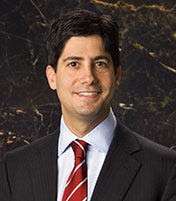
Kevin Warsh was nominated by President Donald Trump in January 2026 to serve as board chair of the Federal Reserve.
As he finally comes up for a vote in the Senate’s banking panel today, we wanted to offer a look into his personal finances.
Most of the coverage focused on his monetary policy views and his time as a Fed governor — a role he held from 2006 to 2011, spanning the administrations of both George W. Bush and Barack Obama.
We looked at his wallet instead.
And it is a George-Costanza-esque wallet.

According to a Hunter Index analysis of Warsh’s OGE Form 278e — the public financial disclosure form he filed on Feb. 25 — Warsh and his spouse reported a combined estimated net worth of $249.68 million. That figure is based on the median value of each disclosed range in his filing, as calculated by Hunter Index.
The Basics
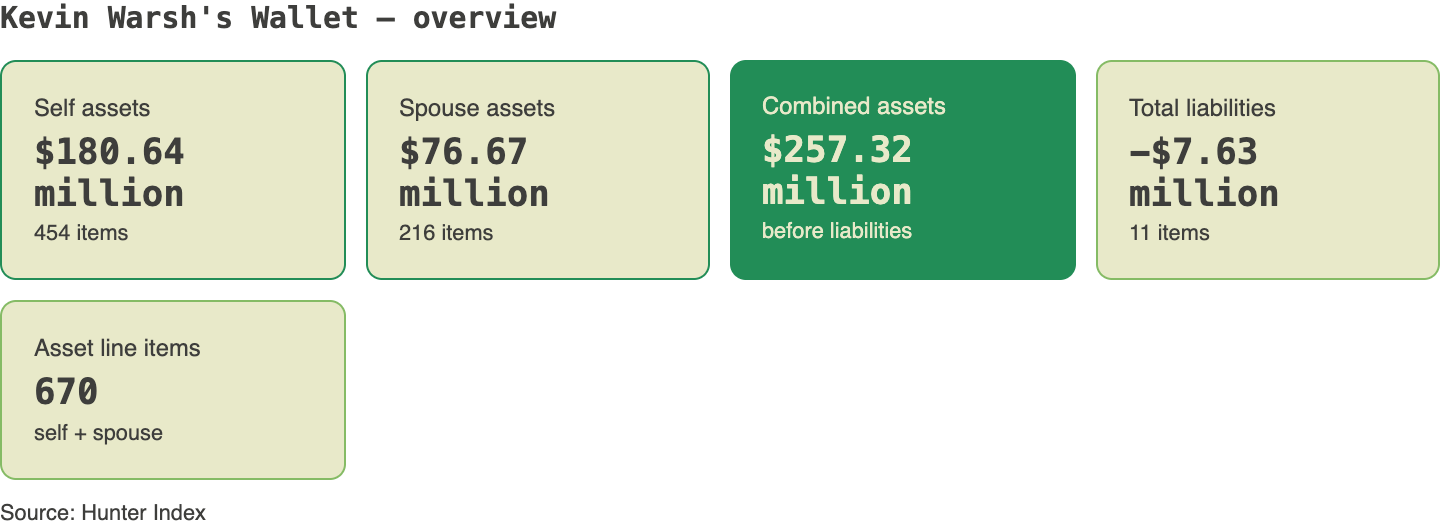
Warsh’s filing lists 670 individual asset line items — a number that reflects the extraordinary complexity of a portfolio built over decades in finance, consulting, and private markets.
That puts Warsh comfortably among the wealthiest individuals ever nominated to lead the central bank.
The Juggernaut in the Room
If there is one number that defines Kevin Warsh’s financial disclosure, it is this: $50 million — listed not once, but twice.
Both entries refer to the same entity: Juggernaut Fund, LP, a private investment fund associated with the Duquesne Family Office of investor Stanley Druckenmiller, whose underlying holdings are confidential under pre-existing investor agreements. Warsh holds it directly, and also indirectly through his personal advisory firm, Vicarage Corporation. Together, the two positions carry an estimated value of at least $100 million — the single largest component of his self-reported portfolio by a significant margin, accounting for roughly 55% of his personally-held assets.
Warsh has publicly said he worked on a venture-capital fund for Druckenmiller. His disclosure also separately lists Duquesne Family Office as a source of consulting income, with Politico reporting indicating he earned $10 million in income from that advisory relationship.
Warsh’s disclosure points to an SEC 13F filing for partial transparency into the Juggernaut Fund’s holdings, but notes that some holdings — specifically Neptune Insurance Holding — are excluded even from that. He has committed to divesting the Juggernaut Fund if confirmed.
It’s All Druckenmiller
Here is what makes that question even larger.
Warsh’s ethics agreement, signed April 10, confirms that every THSDFS LLC series — 85 separate fund series worth an estimated $48.24 million — along with DCM Investments 9 LLC and DCM Investments 10 LLC, are all Duquesne Family Office, LLC entities.
That means Warsh’s combined Juggernaut Fund and THSDFS holdings — roughly 82% of his personally-held assets, estimated at $148.24 million — all flow through a single relationship: Stanley Druckenmiller.
That is not a diversified portfolio. That is a bet on one billionaire.
Warsh has committed to divesting all Duquesne-connected entities within 90 days of confirmation. The question of how one man unwinds $148.24 million in private fund interests tied to one of the most prominent investors in the world — and at what price, and to whom — is one worth asking.
According to an industry source, “It is not possible to divest from the juggernaut holdings within 90 days because they are illiquid venture companies. It will take months/years to divest.”
Would you make a decision that costs your family $148.24 million for the public good? That is what we are asking of Kevin Warsh.
Public Markets: UPS, Coupang, and a Stanford Salary
Beyond the private markets, Warsh holds meaningful positions in two public companies where he has served on the board of directors.
His United Parcel Service UPS 0.00%↑ holdings, in the form of vested phantom stock and restricted stock units, are each estimated at $3 million. He also holds Coupang Inc. CPNG 0.00%↑ — a U.S.-listed company, headquartered in Seattle, that operates as the largest online retailer in South Korea — in two separate entries, each also estimated at $3 milllion.
Both UPS and Coupang paid Warsh director fees. He has committed to resigning his board seats and divesting these positions upon confirmation.
His income sources also include salaries from Stanford University’s Hoover Institution and Graduate School of Business, where he holds a visiting fellowship, and consulting fees from GoldenTree Asset Management, Heitman LLC, Cerberus Capital Management, and Duquesne Family Office — all disclosed as sources of compensation exceeding the $5k threshold for reporting.
The Venture Capital Rabbit Hole
If the 85 THSDFS series wasn’t enough, Warsh also holds interests in a sprawling set of venture capital funds through an entity called Abstract Holdings LLC inside his DCM Investments 10 LLC position — estimated at $375k.
Combined, these funds hold stakes in more than 200 individual startups spanning artificial intelligence, crypto infrastructure, defense technology, biotech, fintech, consumer apps, and beyond. Companies include: Replit, Solana, SpaceX (via xAI acquisition), Databricks, Crusoe, Hebbia, Polymarket, and dozens of others at various stages of development. The individual startup positions are listed as not readily ascertainable in value.
He also holds Bessemer Venture Associates XI LP, worth about $3 million.
A Last-Minute Addition to the Ethics Agreement
On April 17, 2026 — one week after his original ethics agreement was signed — Warsh filed an amended supplement. Ethics officials at the Board of Governors had identified a holding that required an additional divestiture commitment.
The asset: iShares S&P/TSX 60 Index $XIU a Canadian equity index ETF held in the household portfolio. Under the amendment, Warsh committed to divesting it before assuming duties as Fed chair.
The original ethics agreement was signed on April 10. The supplement was filed on April 17. It is a small asset. It is not a small detail.
What’s in the Wife’s Wallet?
Warsh’s wife is Jane Lauder — granddaughter of Estée Lauder, co-founder of The Estée Lauder Companies. Ms. Lauder is currently Global Brand President of Clinique and a member of The Estée Lauder Companies’ board of directors, a position she has held since 2009. She also serves on the board of Eventbrite.
What the disclosure alone does not capture: Ms. Lauder is the managing director of TAW Fund I (d/b/a TAW Ventures) — an active venture fund, not a passive investment. Warsh has committed in his ethics agreement to recusing himself from any Fed matter that has a direct and predictable effect on TAW Ventures or its underlying holdings.
Her largest single asset: undeveloped land in Suffolk County, N.Y., worth an estimated $15 million.
Her next largest holdings include significant positions in Estée Lauder Companies stock across multiple share classes and trusts, a family art partnership worth at least $1 million, and a promissory note from a family member also worth at least $1 million.
Her portfolio also includes a robust collection of municipal bonds — more than 80 individual positions spread across New York, Texas, Connecticut, Alabama, Florida, Michigan, and other states — held primarily through a family trust. Ms. Lauder also holds positions through Lansing Management Onshore LP, a fund with disclosed holdings in public companies including: Interactive Brokers, APi Group, HEICO, TransUnion, Ashtead Group, Moody’s, Ferrari, Hilton, and others.
Her only liability: an outstanding capital commitment to Searchlight Capital LP of $175k, made in 2012.
The Speakers Fee Hangover
Section 10 of the ethics agreement lists five entities from which Warsh received speaking honoraria. For one year after his confirmation, he has committed to not participating in any Fed matter in which these entities are a party:
Warburg Pincus
State Street Bank and Trust Company
Eli Lilly and Company
Centerview Partners LLC
Brevan Howard
State Street is one of the largest custody banks in the United States with an ongoing relationship with the Federal Reserve. That one-year recusal is a meaningful constraint on the incoming chairman from day one.
Her Bonds, His Problem
Attachment B of the ethics agreement lists more than 35 individual municipal bond positions — held primarily in Jane Lauder’s family trusts — that must be divested within 90 days of confirmation.
The bonds span issuers in Alabama, New York, Texas, Connecticut, Florida, Michigan, New Jersey, North Carolina, Oklahoma, South Carolina, Tennessee, and the District of Columbia.
The Federal Reserve’s interest rate decisions affect the borrowing costs of every state and municipality on that list. The ethics agreement requires divestiture. The breadth of the list is its own kind of disclosure.
The Liabilities: Modest, All Things Considered
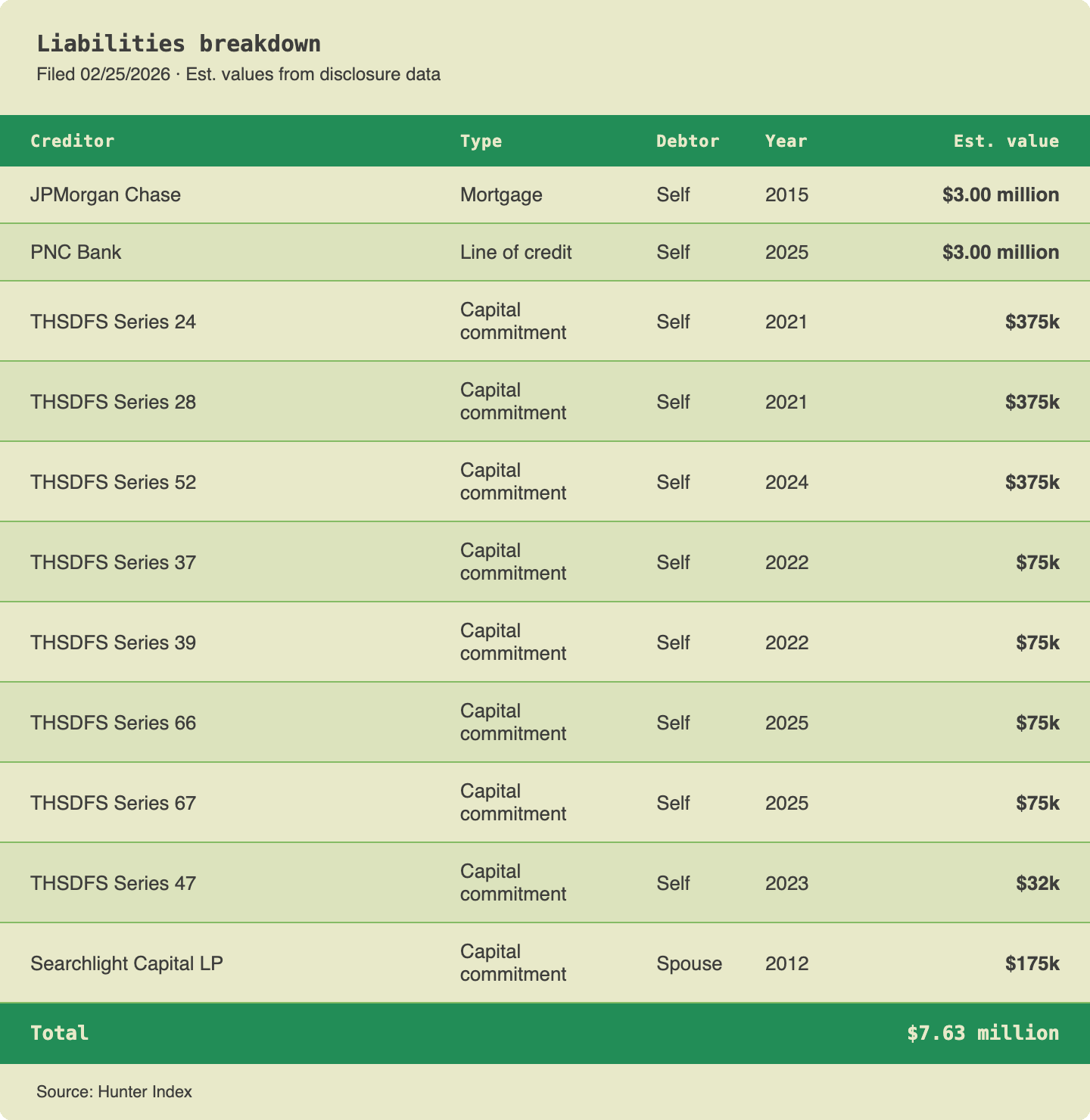
Against a $257.32 million asset base, Warsh’s liabilities are relatively contained — an estimated $7.63 million in total.
The two largest are a JPMorgan Chase mortgage on his personal residence (estimated at $3 million) and a PNC Bank revolving line of credit (estimated at $3 million) taken out in 2025. The remainder are the unfunded capital commitments to various THSDFS fund series, ranging from $32k to $375k each.
Document Dump
Here are all the files we have obtained and used in reporting on Warsh’s personal finances.
Kevin Warsh’s 278e nominee personal financial disclosure form filed on Feb. 25, 2026.
Warsh’s ethics agreement dated April 17, 2026.
Why Does It Matter?
The Federal Reserve sets interest rates that affect mortgages, car loans, credit cards, and business loans in the United States. Its chairman has enormous influence over the cost of money itself.
Kevin Warsh has committed to divesting a long list of assets within 90 days — including both Juggernaut Fund positions, his Bessemer Venture stakes, and all 85 THSDFS series. The question of how a man divests $148.24 million in private fund interests tied to one billionaire — and at what price, and to whom — deserves more scrutiny than it has received.
Also, will Warsh go to the secondary market and sell his assets for below market value to comply with the 90-days divestment period?
Please be informed of your politicians’ personal finances.
That’s our goal at the Hunter Index. We believe it is important for constituents to understand how their government officials’ personal finances may affect their policy-making decisions, as well as being aware of the potential income and wealth gap between many politicians and their constituents.
Remember our favorite questions: Would you make a decision that costs your family money for the public good? Isn’t that what we ask of our government officials?
Note: the largest range for an asset on the financial disclosure forms is open-ended at over $50 million for Warsh’s individually owned assets. It is over $1 million for any assets held solely by a spouse or dependent child.
Managing Hunter Index and its exclusive database, which makes reporting like this article possible, is extremely expensive and labor-intensive.
Please consider becoming a paid subscriber to help fund this nonprofit news organization led by a disabled journalist, or help grow our readership by sharing this publication with others.