



Special government employees (SGE) have been a prominent feature of President Donald Trump’s second term in office.
From Elon Musk during the DOGE-era to Corey Lewandoski in the Kristi Noem DHS-epic, Trump has filled various departments with high-level aides in temporary SGE roles that allow them to avoid most laws mandating public financial disclosures by government officials.
SGEs are temporary government officials who are limited to working (paid or unpaid) for 130 days or fewer in a 365-day period. Historically, they have been used mainly for various advisory board positions.
SGEs have been around since Congress passed legislation approving the role in 1962 with a main purpose of letting outside experts help the federal government on a temporary, usually advisory basis.
Even then, legislators were worried about the ethical risks and potential conflicts of interest according to the CBPP.
Unfortunately, SGEs are not required to file the personal financial disclosure forms that fuel our work here at Hunter Index. Financial disclosure information is also exempt from the main transparency tool available to the public and media — Freedom of Information Act (FOIA) requests.
Since our founding in 2024, our team has always used official data when reporting on the personal finances of government officials to build trust with our readers.
We strive to provide you with accurate and verifiable information provided by the government and the officials that we cover.
Unfortunately, that means efforts to accurately detail the personal wealth of many notable Trump administration officials is unavailable at this time.
The White House annual report to Congress for 2025 lists a few unpaid advisors on Trump’s staff.
In 2025, Senator Elizabeth Warren of Massachusetts introduced legislation to require that SGE officials be held to the ethics standards of other federal employees like public personal finances disclosures and conflict of interest waivers. The Senate bill is cosponsored by 13 other Democrats; the House version has four sponsors — all Democrats. Neither bill has any real chance of passage — let alone being signed into law by Trump — in the Republican-controlled 119th Congress.
However, here’s what we know about the personal finances of three senior SGEs in Trump’s second term.
Elon Musk
Probably the most well-known SGE, Musk served in Trump’s administration in 2025 during the peak of the Department of Government Efficiency’s (DOGE) influence.
Musk has been named as the world’s richest person by numerous outlets. However, the billionaire’s personal finances are largely tied to stock holdings in the various companies that he has worked for or started like Tesla, SpaceX, and X, the company formerly known as Twitter. Bloomberg’s Billionaire Index is a source to track his comically high and fluid net worth of $600 to $800 billion.
Musk ran into potential conflicts of interest due to Tesla & SpaceX’s heavy reliance on government contracts. The two companies have received over $38 billion in government contacts since their creation according to The Washington Post.
Corey Lewandowski
The Republican political operative and former campaign manager for Trump has served as an acting or unofficial chief of staff to Kristi Noem during her time as Homeland Security secretary that ended earlier this year.
Lewandowski has skirted the 130-day limit for SGE’s with creative timekeeping according to Axios.
He has never held public office (although he unsuccessfully ran two campaigns in Massachusetts) but reportedly earned $500k in 2016 working for the Trump campaign.
Due to his career mainly for private companies like Fox News or political organizations like the Republican National Committee that don’t require salary disclosures, any public reporting on Lewandowski is purely speculative and should be ignored.
David Sacks
A venture capitalist and former PayPal executive, Sacks worked as an unpaid advisor on A.I. and crypto to President Trump from January 2025 until March 2026. He still serves as chair of the president’s science and technology advisory council.
Sacks was tasked with helping propose regulations and guidance over the digital asset industry.
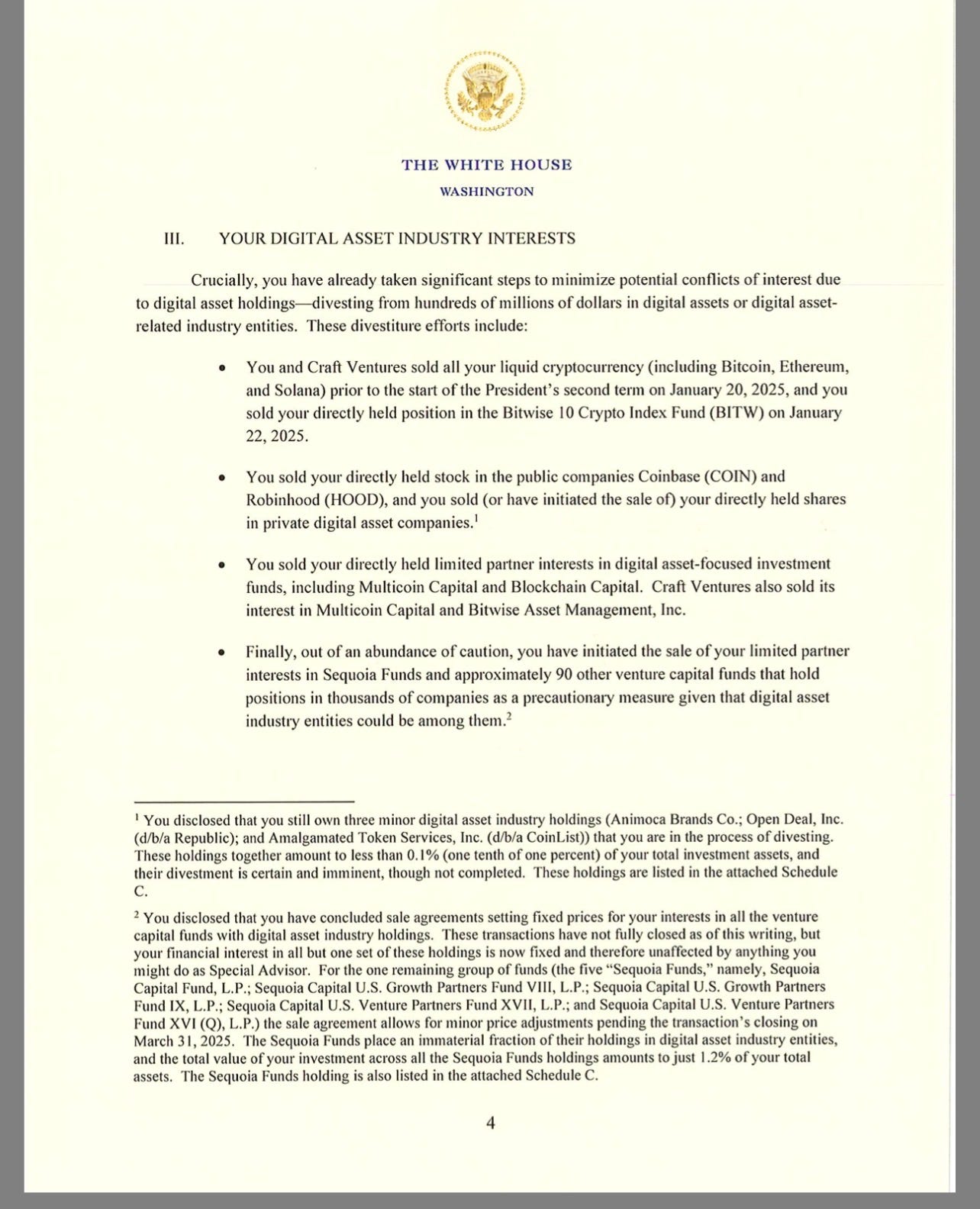
He actually received two conflict of interest waivers from the White House counsel’s office — one on March 5, 2025 and the other is undated.
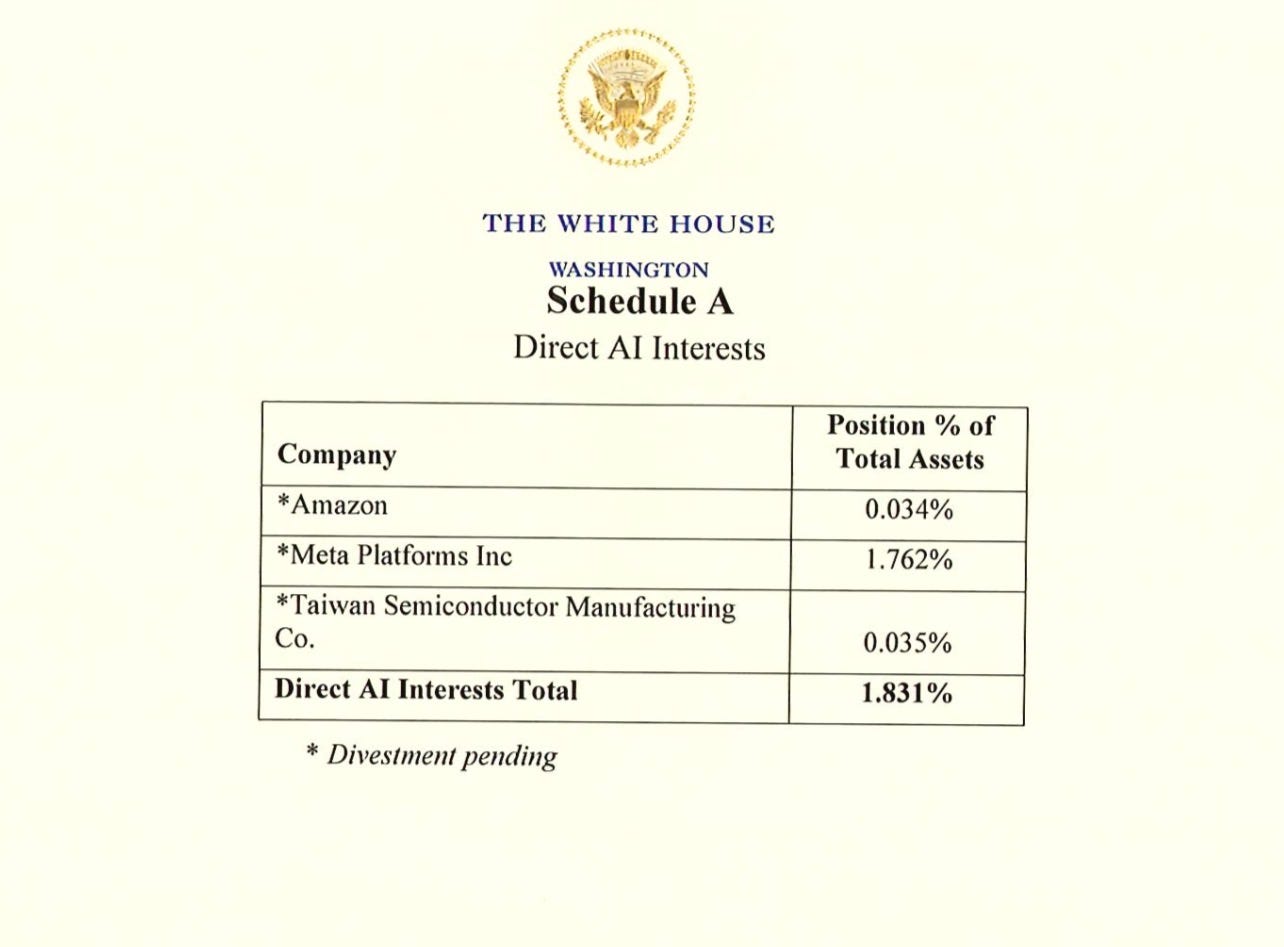
According to Sacks’ waiver, 1.9% of his portfolio’s value is held in AI-related assets “that would be directly and predictably affected” by his government work.
He also claimed to be in the process of divesting from some assets at the time of receiving the waiver like Amazon, Meta and X.AI Corp - a subsidiary of Musk’s SpaceX.
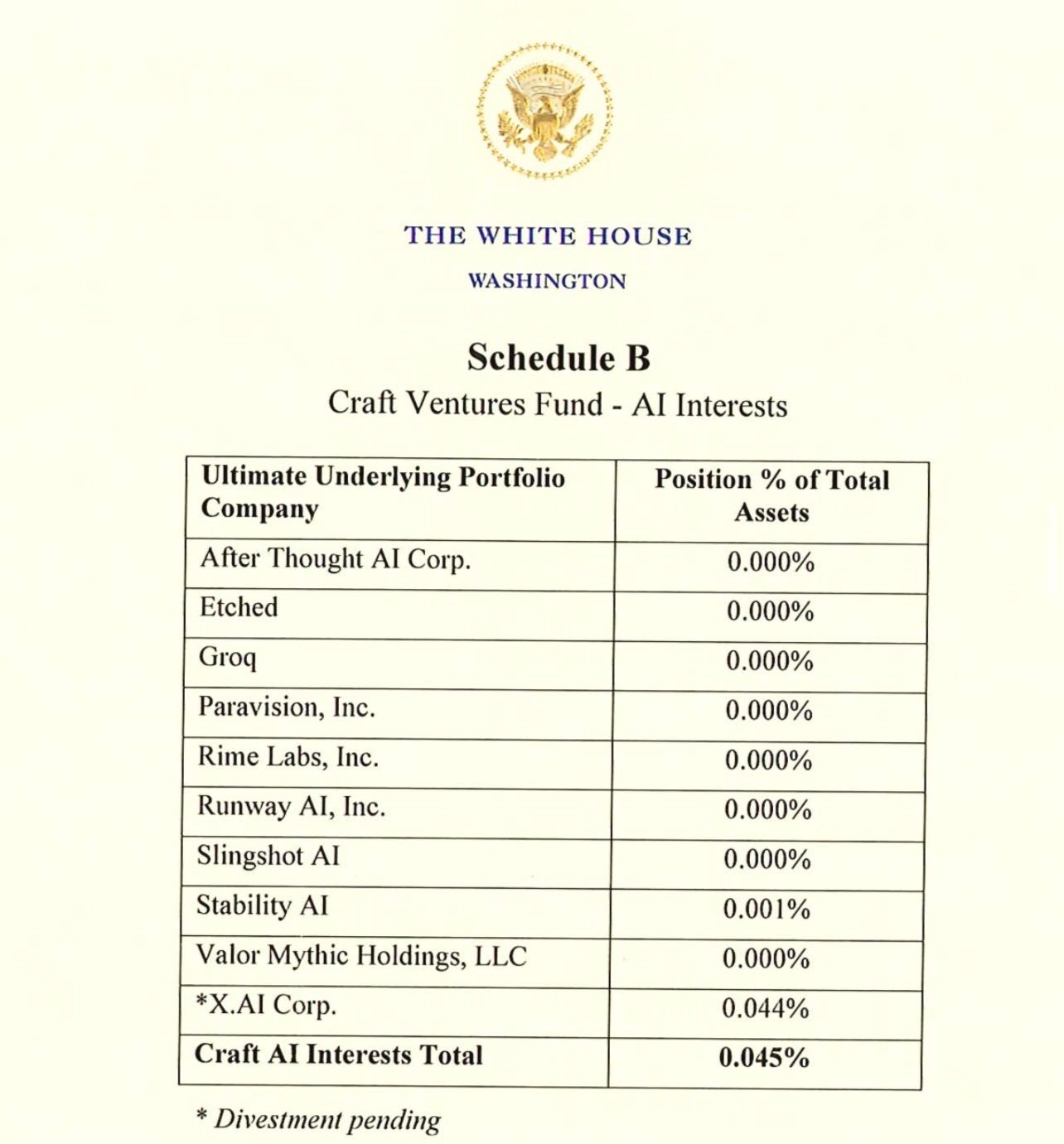
Sacks’ waiver lists other potentially conflicting investments in tech companies like: Palantir; Adobe; Reddit; Salesforce; Snowflake; Tesla; & Quora. White House Counsel David Warrington provided approval for Sacks to retain those investments while advising the president on technology policy.
Sacks also holds a large stake (5.07% of his total portfolio value) in Beldore Capital Fund - a private equity buyout fund that usually requires people to invest at least $1 million in the fund.
To Sacks’ credit, he did divest over $85 million in crypto (Bitcoin, Ethereum and Solana) and other assets before Trump was sworn into office in January 2025. He also divested from his directly-held positions in crypto trading platforms Robinhood and Coinbase. He held onto some investments in other crypto startups.
The New York Times reported on how Sacks’ work as an SGE is benefiting his professional career and personal portfolio.
Unfortunately, even though Sacks has complied with ethics disclosure requirements, they are so limited for SGEs that it’s impossible to get a true sense of the true value of Sacks’ portfolio or how the millionaire has increased his wealth through his government advisory work.
The White House’s Ethics counsel confirmed that “The White House has no disclosures responsive to your request for the following individual: David Sacks.”
Sacks is one of only four senior Trump officials to have conflict of interest waivers as published by The White House at time of publication.

Why Does It Matter?
Please be informed of your politicians’ personal finances.
That’s our goal at the Hunter Index. We believe it is important for constituents to understand how their government officials’ personal finances may affect their policy making decisions as well as understanding the potential wide disparity between their wealth and that of the people in their home state or district.
Remember our favorite questions: Would you make a decision that costs your family money for the public good? Isn’t that what we ask of our government officials?
Managing Hunter Index and its exclusive database which makes reporting like this article possible is extremely expensive and labor intensive.
Please consider becoming a paid subscriber to help fund this nonprofit news organization led by a disabled journalist or help grow our readership by sharing this publication with others.