

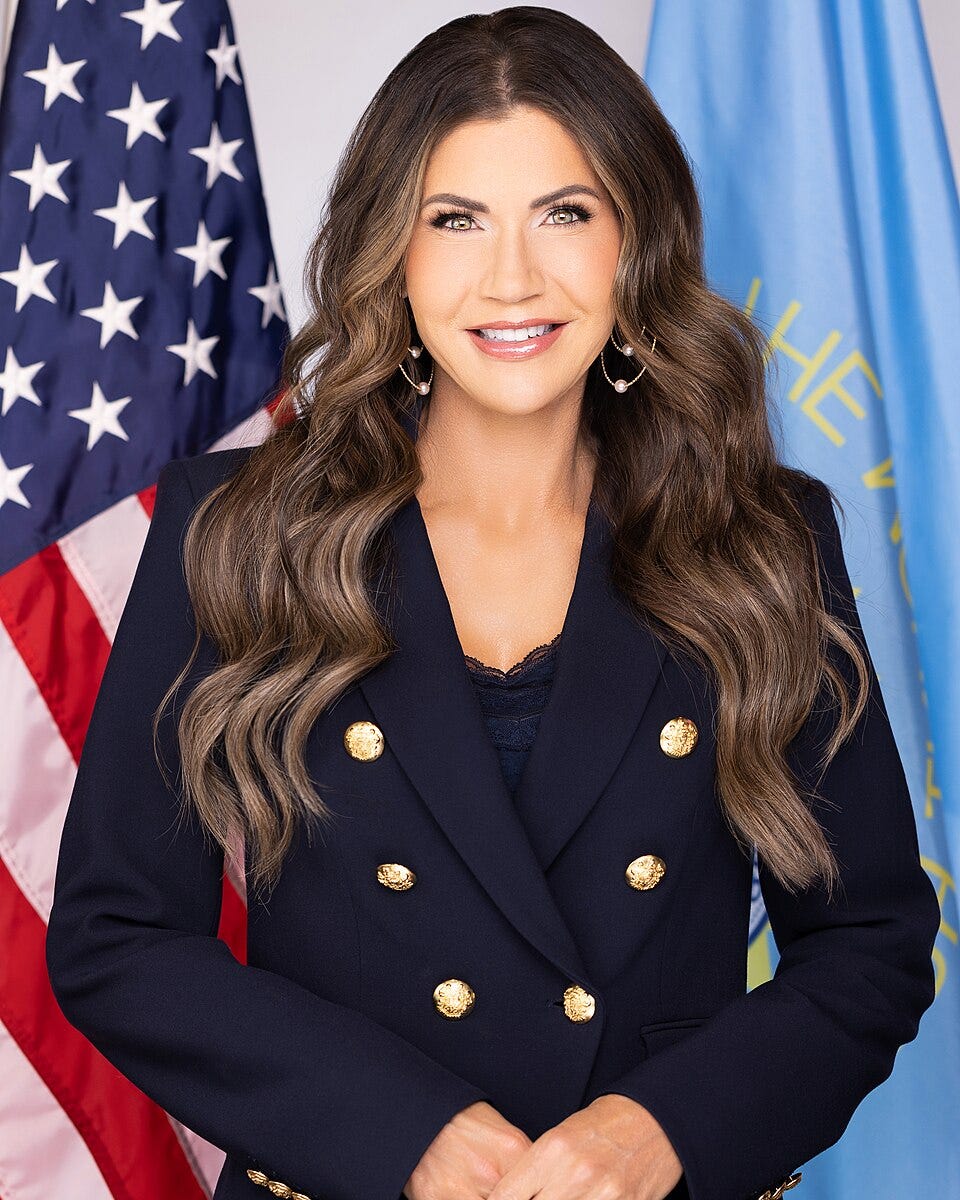
Kristi Noem was only 35 when she entered public life as a member of South Dakota’s House of Representatives.
At the time, her personal financial situation was relatively uncomplicated as could be expected for a part-time legislator and self-described “rancher/media relations/children’s ministries” professional.
Noem’s husband Bryon “worked” for her as an employee on the ranch owned by Noem according to her state-level disclosure forms from 2006 onwards. Bryon also worked as an insurance agent with Bryant State Bank. Later, Bryon bought out the insurance agency portion of the bank and spun it off as his own independent company — Noem Insurance.
After Hunter Index’s comprehensive efforts obtaining both state and federal personal financial reports filed by Noem, we can track their household’s financial growth over the last 20 years.
In 2010 when she first ran for Congress, Noem held $89k in personal assets — investments in two ethanol plant companies, a pasture and two retirement accounts. She also held about $25k in revolving debt on two credit cards.
In 2009, the Noems earned income from Kristi’s state house seat ($6k salary and $4,129.19 in per diem); $7.5k of hunting fees; $27k salary from Family Worship Center; and an undisclosed amount from Bryon’s job at the bank.
In 2012, Noem was ranked as the 456th wealthiest member of Congress (out 541 members) with at least $522k in assets but $750k in liabilities including a mortgage according to my reporting at the time with my Roll Call colleagues.
Today, the Noem household owns assets worth roughly $5.7 million. Kristi holds an estimated $672k in assets, and her husband owns roughly $4.5 million in assets. They also own about $500k jointly in assets like the pasture land. They also owe at least $2.6 million in debts mainly loans tied to Bryon’s business ventures and a mortgage on their personal residence.
So, how does a public official’s and an insurance agency owner’s wealth grow so much in a little over a decade? Let’s try to find out….
Noem Insurance
Kristi Noem’s government salaries and her husband Bryon’s decision to start his own insurance business fueled their portfolio growth.
When Byron started his independent agency selling crop and other policies in January 2010, the Noem’s valued the agency at $550k. The agency generated $175k in profits for them in the first year. However, they did take out at least $500k in loans with Dacotah Bank in Aberdeen, S.D. to finance the acquisition of the business from Bryant Street Bank, Bryon’s former employer. Kristi reported equal 50% ownership stakes of the agency with her husband until she was sworn into Congress in January 2011.
Their other assets at the time were investments in the two ethanol plants in Granite Falls, Minn. and Watertown, S.D. worth about $65k; the Florence Township pasture that generated about $10k in rental income annually; and some investment accounts like Roth IRAs and money market accounts worth roughly $40k.
Kristi Noem served in Congress for eight years, earning $174k annually.
In 2018, she decided to run successfully for governor of South Dakota.
In 2019, when she transitioned into her gubernatorial role, the family’s portfolio was essentially the same as when she entered Congress. They still owned the investments in the ethanol plants, their rental pasture and IRA’s and also owed money on the 2010 business loan for Noem Insurance.
However, Noem Insurance had become very successful and was worth about $2.5 million and generated roughly $500k in annual income for the family excluding Bryon’s individual compensation — over $1 million annually by 2025. Bryon also worked as a basketball coach for Hamlin High School in Bryant for an undisclosed amount - but presumably not much.
Kristi served as South Dakota governor until President Donald Trump appointed her to his Cabinet as Homeland Security secretary in 2025.
During her gubernatorial stint, Bryon added ownership of a car wash business and Kristi received royalties for her two books published in 2022 & 2024.
When Kristi joined President Trump’s administration, her portfolio was essentially unchanged except for her gubernatorial compensation. Her IRA had grown steadily to be worth about $400k invested in mutual funds and S&P 500 index funds managed by Fidelity, Schwab, T. Rowe Price and Vanguard. She also held about $175k in a bank account and livestock and equipment worth about $75k.
Her annual gubernatorial salary was $241,519 and her state pension was worth $75k. She also received $180k in advances for her books.
Bryon had grown his business to include commercial real estate worth at least $1 million including a car wash business in the state capital of Pierre. He reported earning $1.1 million in annual compensation from his solely-owned agency. However, the business was leveraged with mortgages and other loans — mostly with their original lender Dacotah Bank.
Their rental pasture land’s value had increased to about $375k by 2025.
They still jointly held a mortgage on their private residence, but the debt was between $100k and $250k.
What Are We Missing?
According to reports by ProPublica, Noem likely received undisclosed income totaling $80k through her personal consulting business that she started while serving as governor. ProPublica also reported that a company with close personal ties to her received $220 million in DHS contracts (with no competitive bidding process) for an ad campaign featuring Noem while she was secretary.
In March 2026, a U.S. Senate committee held a hearing with then-Secretary Noem where she was asked about the contracts. “I did not have anything to do with picking those contractors,” she said according to The Hill.
Why Does It Matter?
Please be informed of your politicians’ personal finances.
That’s our goal at the Hunter Index. We believe it is important for constituents to understand how their government officials’ personal finances may affect their policy making decisions as well as understanding the potential wide disparity between their wealth and that of the people in their home state or district.
Remember our favorite questions: Would you make a decision that costs your family money for the public good? Isn’t that what we ask of our government officials?
Managing Hunter Index and its exclusive database which makes reporting like this article possible is extremely expensive and labor intensive.
Please consider becoming a paid subscriber to help fund this nonprofit news organization led by a disabled journalist or help grow our readership by sharing this publication with others.